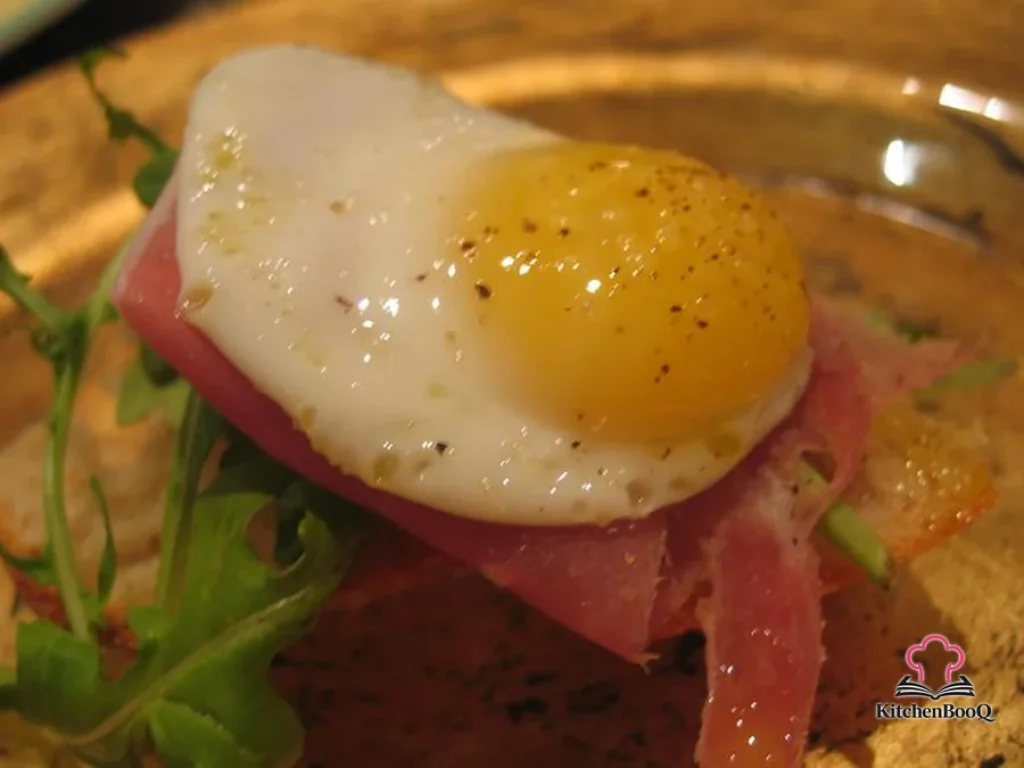
Ingredients
6 quail eggs
6 slices baguette (sliced ¼” thick) OR 6 slices rustic bread warmed and cut to 1/4” thick and about 2 inches wide
handful of baby arugula
6 thin slices proscuitto (or duck proscuitto to be found in specialty stores – even better!)
sea salt (I used Himilayan Pink — but any sea salt will do)
pepper
olive oil
squeeze of lemon (optional)
Instructions
1
Warm the baguette or rustic bread and cut to indicated size.
2
Place small amount of baby arugula, and proscuitto (folded in fours) on each bread.
3
Fry quail eggs in olive oil over medium low heat, basting yolks gently at end. (They will cook very quickly).
4
Place a quail egg on each bread/arugula/proscuitto portion.
5
Sprinkle with sea salt and a little fresh ground pepper.
6
Add squeeze of lemon and enjoy.
Key Points About Ingredients:
- Quail eggs are smaller and richer than chicken eggs, cooking in as little as 60–90 seconds — watch them closely to keep the yolk runny.
- Prosciutto is a dry-cured Italian ham that adds a silky, intensely savory depth without any cooking required.
- Baby arugula provides a peppery, slightly bitter contrast that cuts through the richness of the egg and prosciutto beautifully.
- Himalayan pink salt and other sea salts offer trace minerals and a cleaner, more complex flavor than standard table salt.
- A squeeze of fresh lemon at the end brightens all the flavors and adds a welcome acidity to balance the fat.
- Duck prosciutto, available at specialty stores, has a deeper, gamier flavor that elevates this recipe to restaurant-quality status.
Key Nutritional Insights:
- Quail eggs are nutrient-dense, providing high-quality protein, choline, and B vitamins in a very small package.
- Prosciutto contributes significant sodium, so the added sea salt can be used sparingly depending on your dietary needs.
- Olive oil used for frying adds heart-healthy monounsaturated fats that support cardiovascular health.
- Arugula is a cruciferous green rich in vitamin K, folate, and antioxidants, making these bites more nutritious than they appear.
- This appetizer is naturally low in carbohydrates relative to its protein and fat content, making it satisfying in small portions.
Nutrition Facts
- Serving Size1
- Amount per serving
- Calories165
- Standard DV% Daily Value*
- Total Fat9 g72 g12.5%
- Saturated Fat2.5 g20 g12.5%
- Trans Fat0 g
- Polyunsaturated Fat1.2 g
- Monounsaturated Fat4.8 g
- Cholesterol105 mg300 mg35%
- Sodium420 mg2300 mg18.26%
- Total Carbohydrate13 g275 g4.73%
- Dietary Fiber0.5 g28 g1.79%
- Total Sugars0.5 g
- Added Sugars0 g50 g0%
- Sugar Alcohal0 g
- Protein8 g50 g16%
- Vitamin D (Cholecalciferol)18 mcg20 mcg90%
- Calcium40 mg1300 mg3.08%
- Iron1.2 mg18 mg6.67%
- Potassium95 mg4700 mg2.02%
- Vitamin A310 mcg900 mcg34.44%
- Vitamin C (Ascorbic Acid)2 mg90 mg2.22%
- Vitamin E (Tocopherol)1 mg15 mg6.67%
- Vitamin K28 mcg120 mcg23.33%
- Vitamin B1 (Thiamin)0.12 mg1.2 mg10%
- Vitamin B2 (Riboflavin)0.18 mg1.3 mg13.85%
- Vitamin B3 (Niacin)1.4 mg16 mg8.75%
- Vitamin B6 (Pyridoxine)0.08 mg1.7 mg4.71%
- Folate22 mcg400 mcg5.5%
- Vitamin B12 (Cobalamine)0.4 mcg2.4 mcg16.67%
- Biotin5 mcg30 mcg16.67%
- Vitamin B5 (Pantothenic acid)0.5 mg5 mg10%
- Choline75 mg550 mg13.64%
- Phosphorus110 mg1250 mg8.8%
- Iodine8 mcg150 mcg5.33%
- Magnesium12 mg420 mg2.86%
- Zinc0.8 mg11 mg7.27%
- Selenium10 mcg55 mcg18.18%
- Copper0.05 mg0.9 mg5.56%
- Manganese0.2 mg2.3 mg8.7%
- Chromium1 mcg35 mcg2.86%
- Molybdenum4 mcg45 mcg8.89%
- Chloride310 mg2300 mg13.48%